
Last updated September 20, 2026
Free on-site gate assessment - hinges, posts, and your LiftMaster or Nice gate operator checked before anything is quoted
The assessment is free and the quote is the invoice.

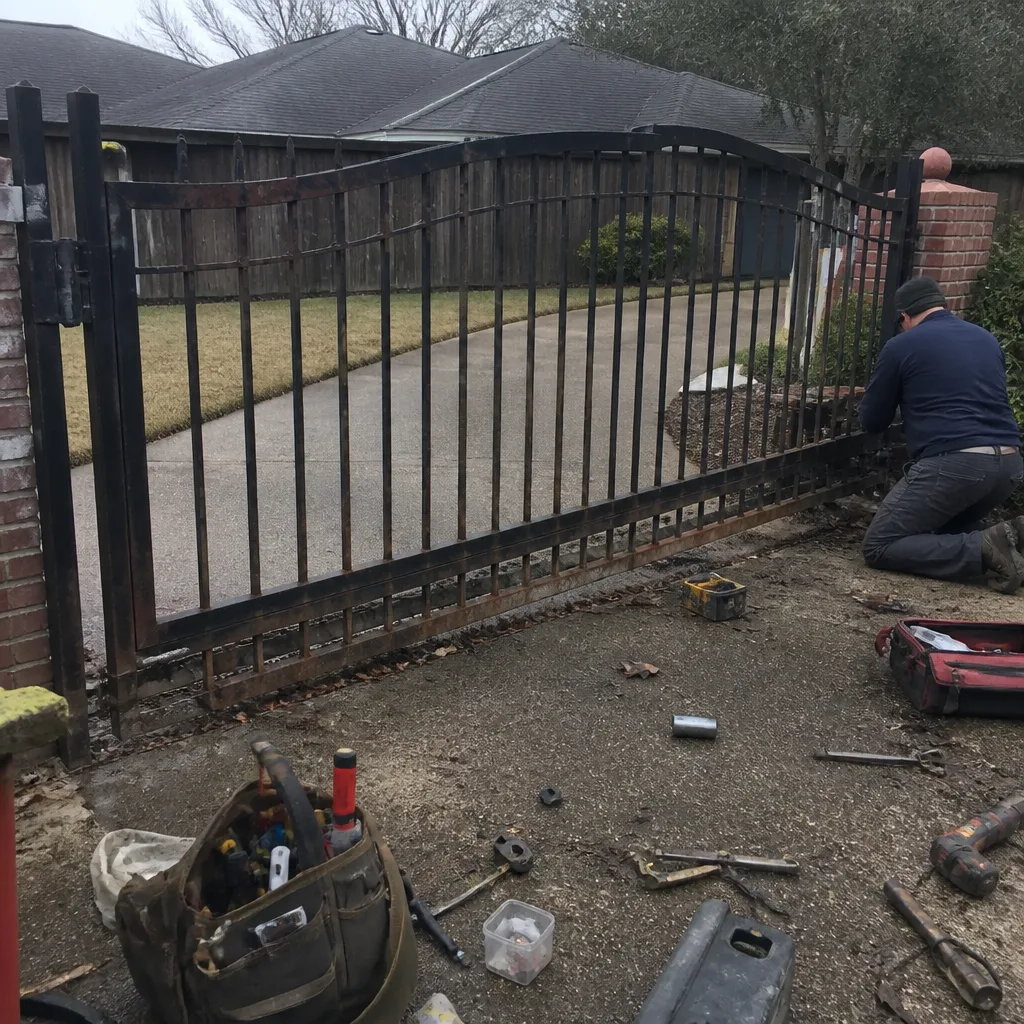 Before
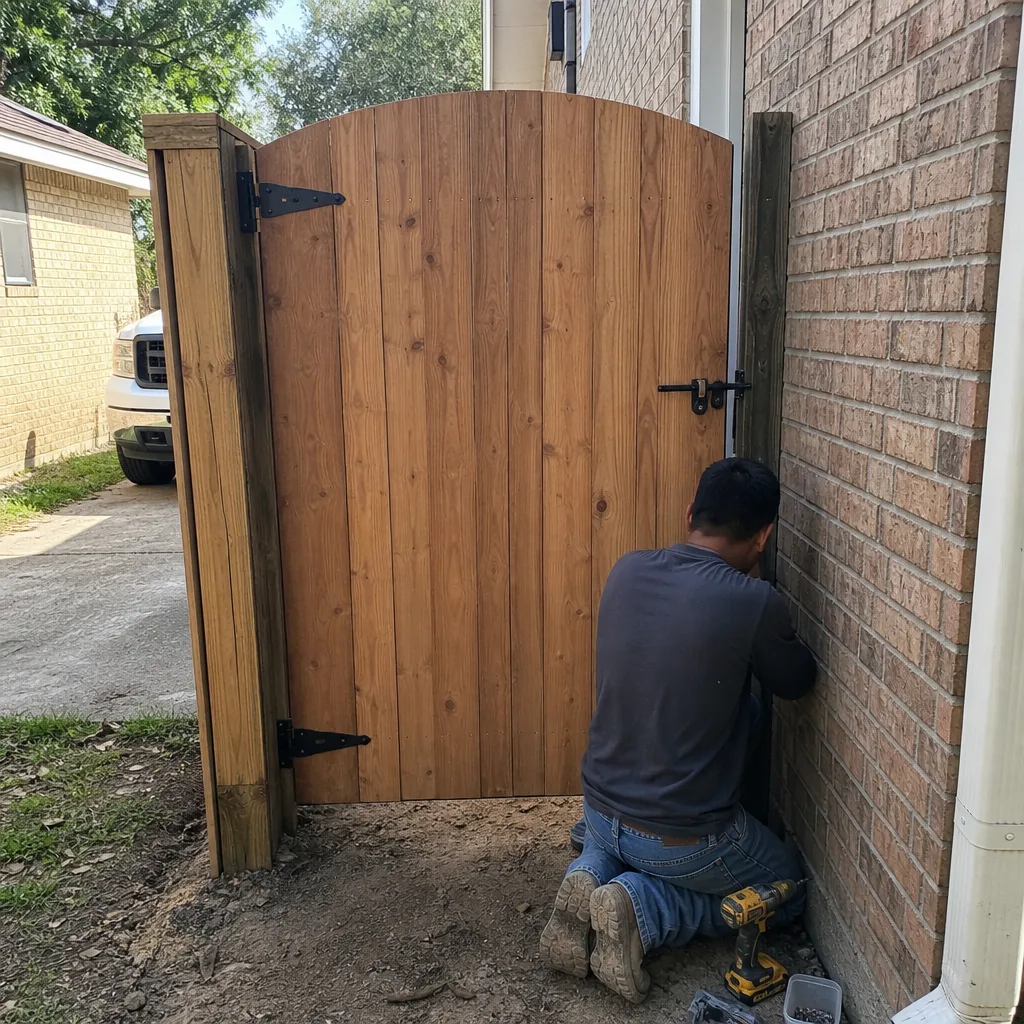 After
After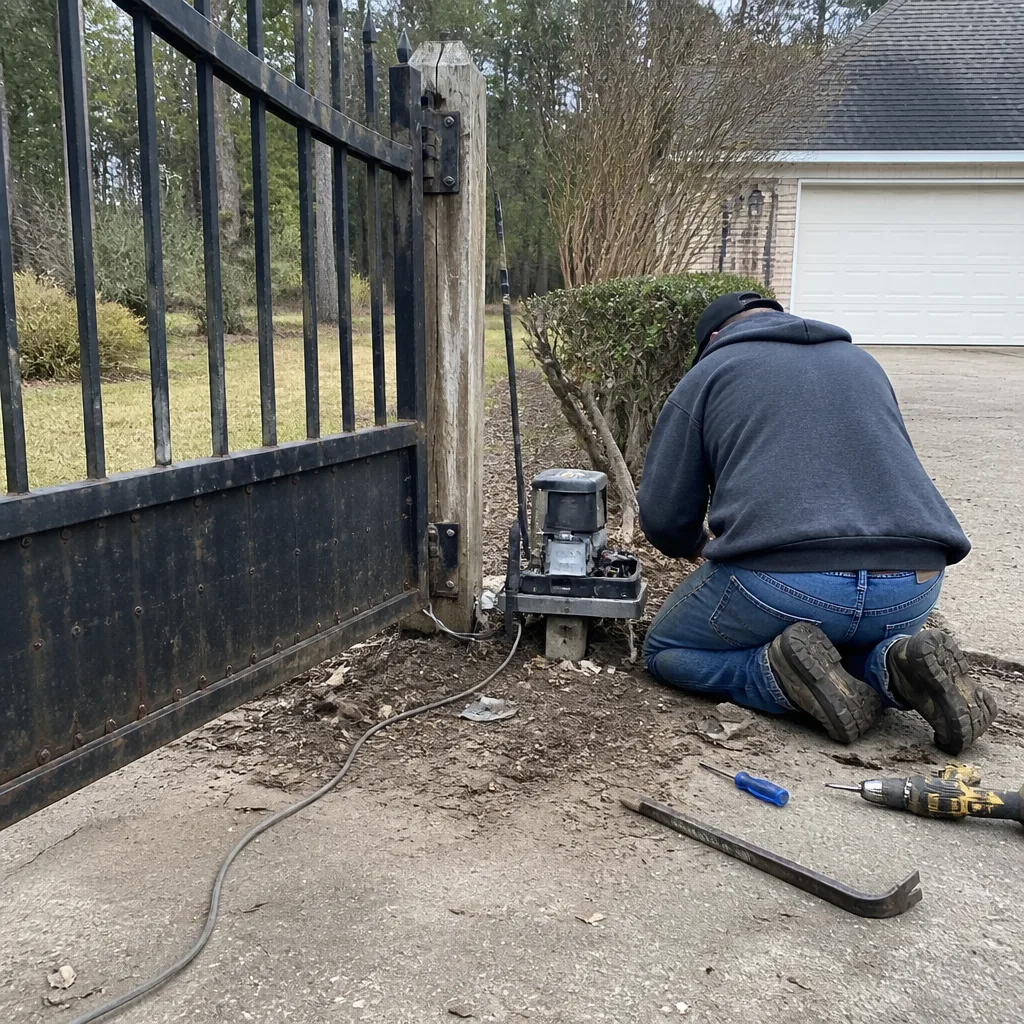 Before
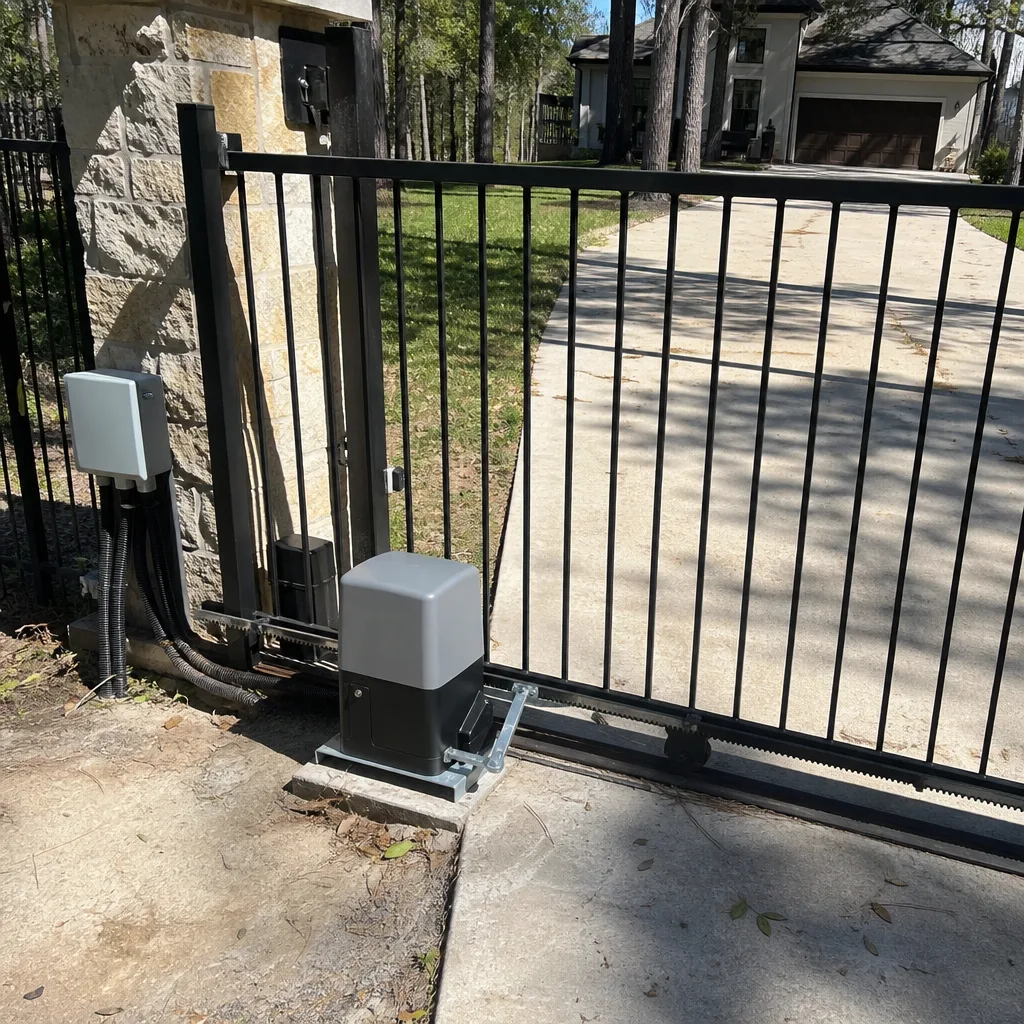 After
After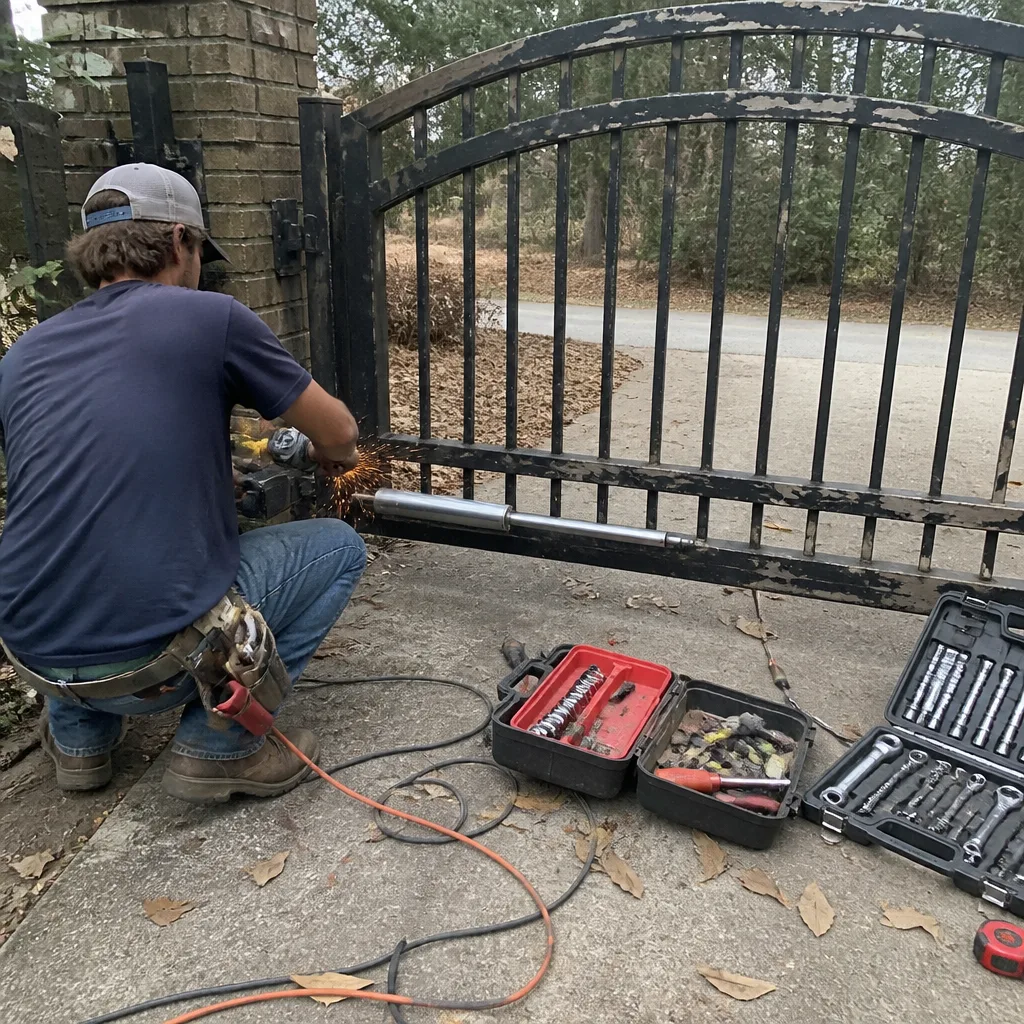 Before
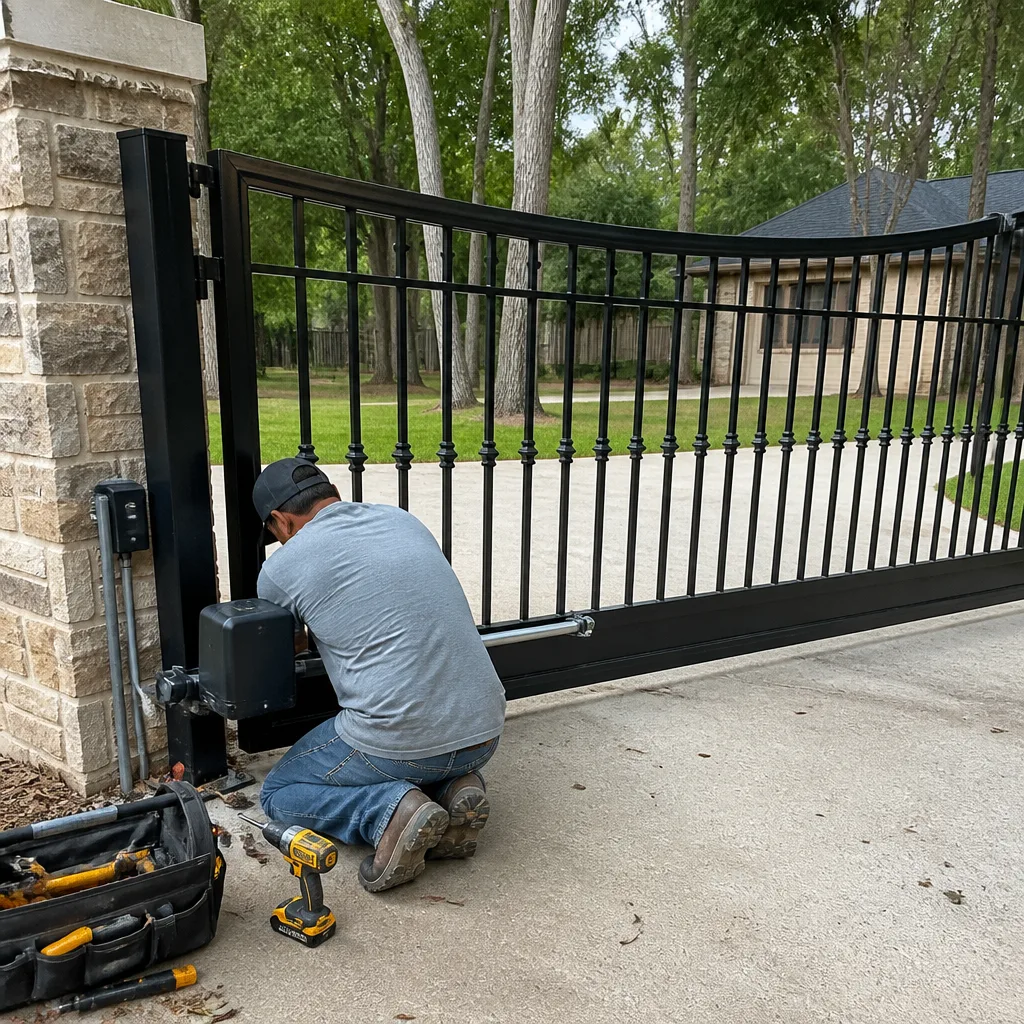 After
AfterGate Repair Warning Signs: A Tomball Homeowner’s Reference Guide
A gate that hesitates for two seconds before moving isn’t “slow.” It’s drawing excess current to overcome mechanical resistance, and that pattern, logged over three weeks, predicts the service call date more accurately than most diagnostics. Tomball homeowners live with automatic gates that talk constantly: through the pitch of the motor, the way the leaf sits on its hinges, the rhythm of the open-close cycle. This guide maps those signals to their causes so you can name the problem before you pick up the phone, and you can find more guides & resources on our blog. What follows is the reference we wish every customer had before the gate stopped mid-cycle with the car trapped on the wrong side.
Quick Answer
Gate failures in Tomball announce themselves through four channels: mechanical sound (grinding, clicking, thumping), timing changes (slower open, pause before move, reversed travel), visible misalignment (drooping leaf, new gaps, rust bloom at weld points), and operator behavior (breaker trips, remote range shrinking, sensor faults). Each channel points to a specific component. Each has a window: some allow scheduled repair, some demand same-day response. If your gate makes a new sound or changes its rhythm, document it and call our Gate Repair services before the failure leaves a two-ton leaf blocking the driveway.
Table of Contents
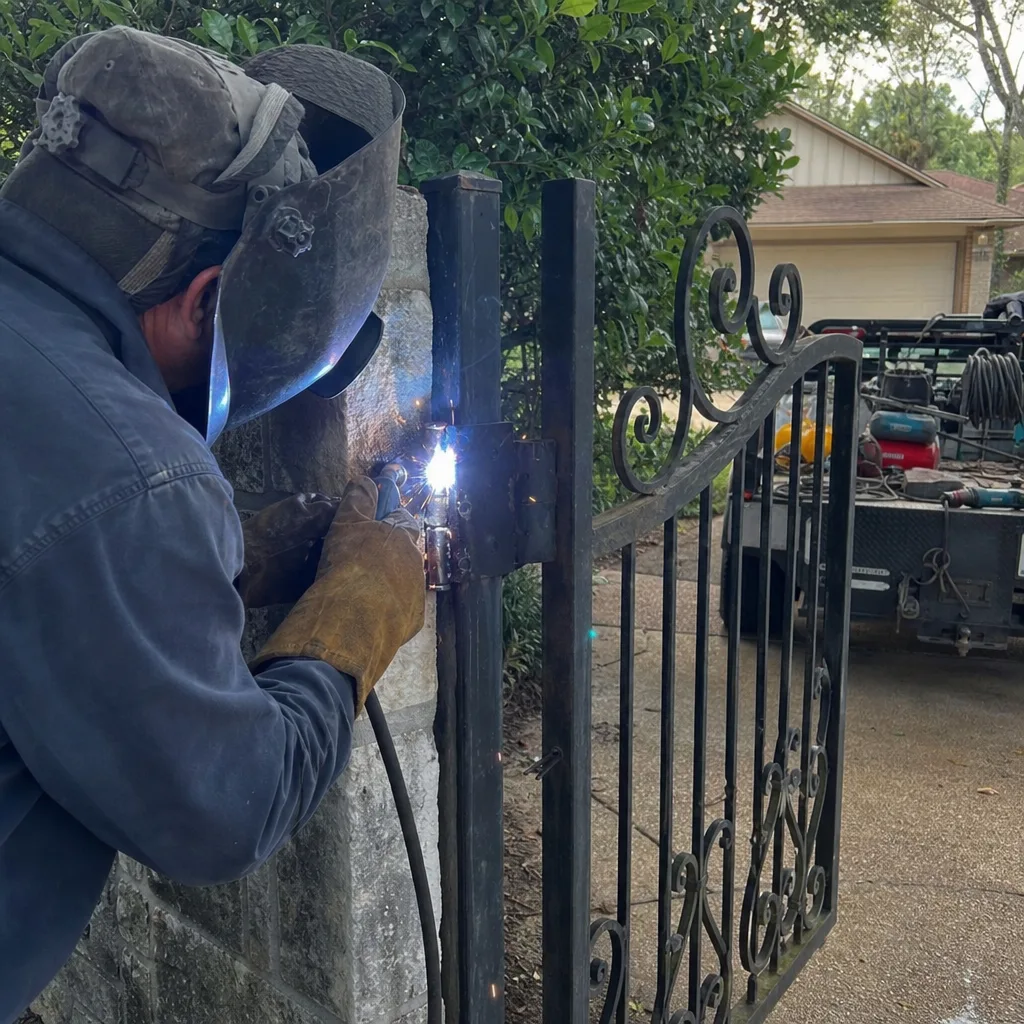
- Mechanical Warning Signs: What the Gate Itself Tells You
- Electrical Warning Signs: Power, Wiring, and the Control Board
- Operator Warning Signs: Motor, Limits, and Remote Behavior
- Access Control Warning Signs: Keypads, Photo-Eyes, and Safety Edges
- Tomball-Specific Warning Signs: Humidity, Clay Soil, and Heat
- The Sound Reference Table: What Each Noise Implicates
- How to Document a Warning Sign So a Technician Can Diagnose Remotely
- Scheduled Repair vs. Imminent Failure: Which Signs Allow a Window
- Common Mistakes to Avoid
- When to Call a Professional
- Frequently Asked Questions
- The Bottom Line
BeforeAfterMechanical Warning Signs: What the Gate Itself Tells You
A gate’s mechanical system carries all the weight and all the weather. In Tomball, that means steel and aluminum living with ninety-percent humidity, afternoon thunderstorms, and soil that moves seasonally. The gate leaf, its hinges, the wheels or rollers, the track if there is one, the chain or belt, and every bracket between them: each has a failure signature.
A drooping gate leaf is the most common mechanical warning in Tomball, and the most commonly ignored. A gate that hangs two degrees low at the latch side is no longer carrying its load through the hinge post: it is levering against the hinge welds and the operator arm. Homeowners see it as “the gate always looked like that.” It didn’t. The droop means the hinge bushings or the post itself has shifted, usually because the hinge post footing settled in clay soil that expands and contracts with every rain cycle.
A gate that scrapes or drags at one point in its travel arc tells you the leaf has moved out of plane or the ground has risen beneath it. The scrape isn’t the failure; it’s the symptom. The failure is whatever moved: hinge pin wear, post deflection, or clay heave under the post footing. Left alone, the drag becomes a grind, the grind becomes a bind, and the bind burns out the operator.
New gaps at hinge points are a Tomball-specific tell. High humidity and seasonal rain cause post footings to move; the movement shows up first as daylight between the hinge bracket and the post. If you can see a gap where there was none, take a photo with your phone next to a coin for scale. That photo is worth more than a verbal description when a technician triages the call.
Wheels that bind or track that deforms on slide gates follow the same pattern. A wheel that no longer turns freely skids on the track instead of rolling, which is why you hear a rhythmic thump or a metallic scrape on a slide gate. It means the wheel bearing is done or the track is out of level. Both are repairable; neither requires gate replacement.
What mechanical symptoms share is a slow onset and a predictable progression. That’s the good news: most mechanical warnings allow a scheduled repair window if you act when the symptom appears.
Electrical Warning Signs: Power, Wiring, and the Control Board
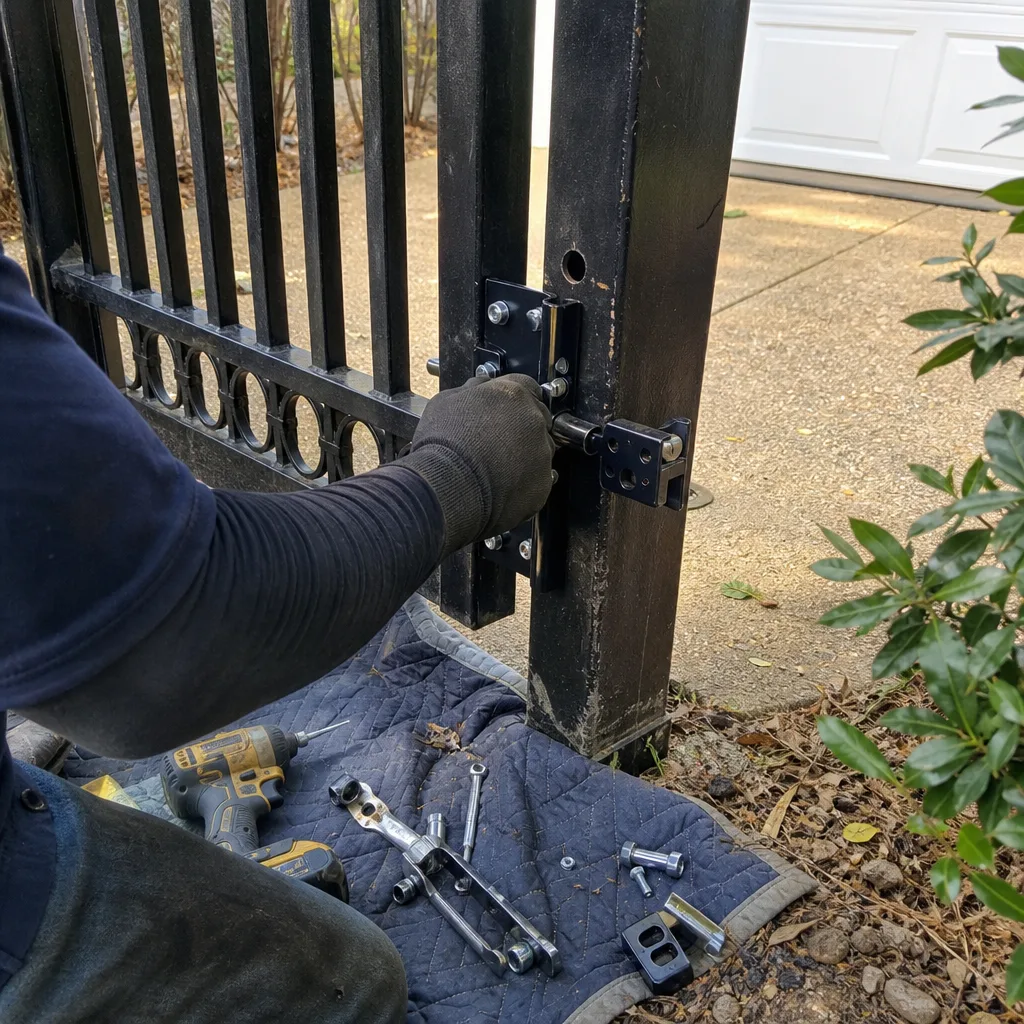
Electrical warnings are the ones that surprise people, because they often begin before anything visible or audible happens at the gate itself. A warm outlet, a breaker that trips once, a remote that works at ten feet but not twenty-five: these are electrical signals from a system under strain.
A breaker that trips intermittently is not a nuisance; it’s a message. The gate circuit usually runs on a dedicated breaker. If it trips once, you can reset it and note the date. If it trips twice in a month, the circuit is pulling current it wasn’t designed to handle. Common causes in Tomball: a motor capacitor failing in the heat, a control board with a corroded relay, or a wire that’s lost insulation and is shorting when it rains.
A hot outlet or a burning smell near the operator housing is the rare electrical warning that means stop using the gate immediately and cut power at the breaker. A hot surface on the operator box or a smell like hot plastic points to a failing transformer on the control board. We’ve seen boards in Tomball garages run ten years without issue, and we’ve seen three-year-old boards cooked by humidity and lightning-adjacent surges. The board in your gate answers to the same power grid, and the same storms, as everything else in the house.
Dimming or flickering when the gate runs in the house circuit suggests high start-up draw on a motor that’s fighting resistance. It shows up most often on older Viking units where the capacitor is original to the install. The cap fails slowly: the gate still runs, but it pulls more amps to start, and the lights on the same circuit blink.
Remote range shrinking is sometimes electrical, sometimes operator. If two different remotes both lose range at the same time, suspect the receiver board or antenna on the gate side rather than the remotes. Tomball’s growing canopy, new construction, and even a neighbor’s new wireless equipment can interfere, but a sudden drop in both remotes points at the gate’s own receiver.
Electrical warnings are the least intuitive to diagnose and the easiest to misread. When in doubt, power down and call before the symptom becomes a welded relay.
Operator Warning Signs: Motor, Limits, and Remote Behavior
The operator is the unit that does the work. You may know it as the motor or the opener. It thinks with a control board and acts through a gear train, arm, or chain drive. Its warning signs are some of the most diagnostic because the operator is the only part of the system with a voice: it buzzes, clicks, hums, and grinds.
A gate that moves slower than it did last season is usually the operator fighting a mechanical problem or running on a tired capacitor. Slow is not a setting. When a Linear or Ghost Controls unit loses five seconds of travel time across two months, something changed: hinge friction, low voltage, a gear train running dry. The slower cycle tells you the motor is loaded beyond its normal curve.
A gate that stops, reverses, or reopens before reaching the limit tells you the operator’s brain is getting bad data or hitting an obstruction. On a Linear unit, this may be the limit cam. On a DoorKing slide, it may be an inherent obstruction sensor picking up a warped section of track. When a gate reverses for no visible reason, document it: time of day, weather, where in the arc the reversal happens.
A motor that runs but the gate doesn’t move is a broken coupling, shear pin, or chain. The sound is distinctive: motor whine with no movement. This is a shutdown-now warning. Running the motor against a broken mechanical link can destroy the gear train in minutes.
Clicking without motor start usually points to the capacitor, the start relay, or a dead spot on the armature. A single click when you press the button, then nothing, is the relay trying and failing to close. Multiple rapid clicks are the board hunting for a signal.
A gate that slams rather than slows at the end of travel means the limit switch or the internal slow-down circuit is failing. If your gate used to decelerate and now hits the stop hard enough to rattle the pickets, the limit switch is no longer registering the approach. It will get worse, and every hard stop adds impact load to the hinges and the post.
Operator symptoms map cleanly to components once you know what to listen for. The sound table later in this guide connects each noise to its likely source.
Access Control Warning Signs: Keypads, Photo-Eyes, and Safety Edges
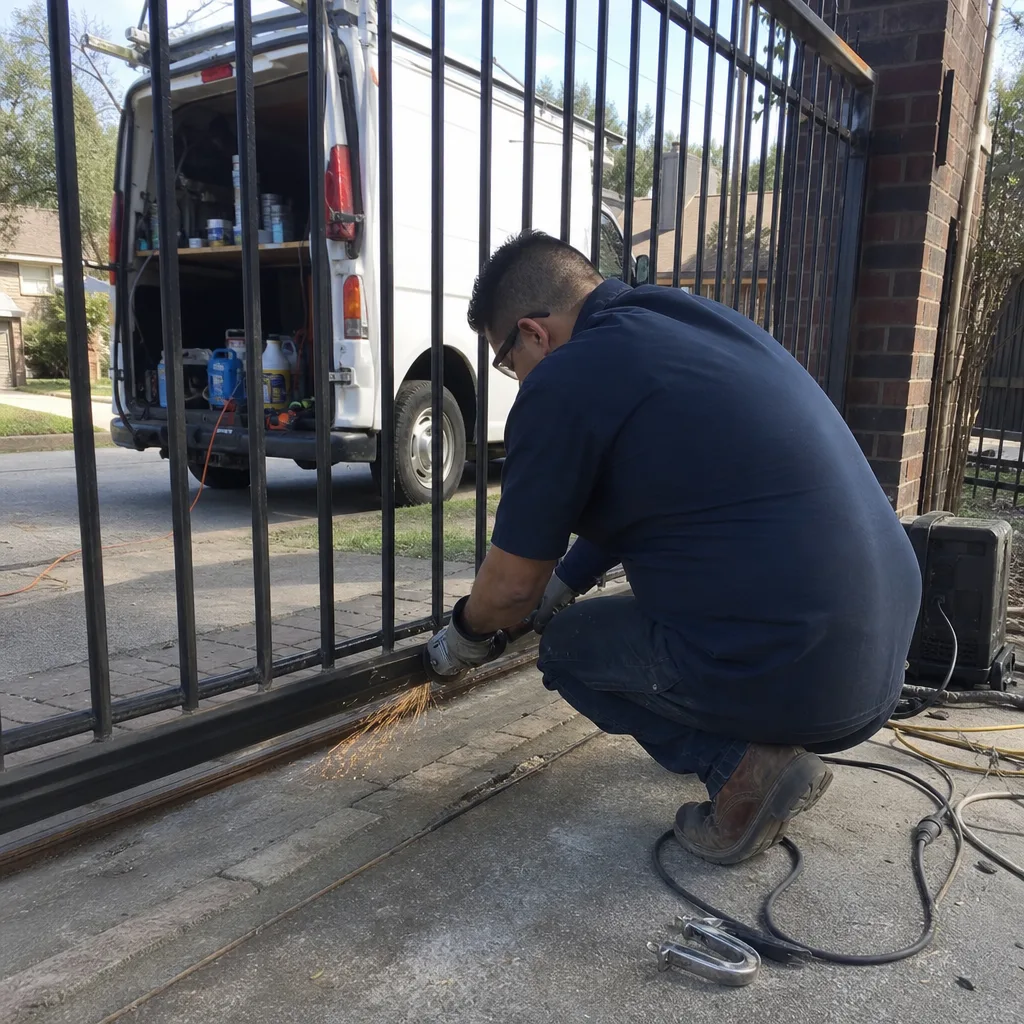
Access control means everything between the user and the operator: keypads, remotes, intercoms, vehicle sensors, photo-eyes, and safety edges. These components fail in their own ways, and they’re often the part of the system a homeowner can test without opening the operator housing.
Keypad buttons that require double presses are the earliest keypad signal. A worn membrane or corroded contact under the button means the first press doesn’t register every time. You type the code, the gate ignores you, you type it again. It feels like user error. It isn’t.
A photo-eye that blinks or faults intermittently often fails at the same time of day or the same weather. A photo-eye, the infrared beam that stops the gate when something crosses the path, may work all morning and fault by late afternoon when the sun hits the receiver at a low angle. Humidity and spider webs across the lens do the same in Tomball. Intermittent faults are a warning that the sensor needs cleaning or repositioning, not replacement.
A safety edge that’s cracked, brittle, or unresponsive is a code-level concern. The safety edge is the pressure strip along the leading edge of the gate that reverses the operator if it contacts a person or vehicle. In Tomball’s sun, the rubber shell hardens and cracks. A hardened edge may still function electrically but won’t compress on impact the way it’s designed to. When we see an edge with visible cracks on a Tomball driveway, we flag it for the customer even when they called for something else.
Vehicle sensors that trigger for no reason, or stop triggering, speak to the loop detector or the wire loop under the driveway. Loop failure is common in Tomball where soil movement and driveway repair break the loop wire. A gate that opens for the UPS truck but not for your car is a loop sensitivity or break issue.
Access control warnings are the best candidates for a homeowner to document with photos and simple tests, because the components are visible and the symptoms are repeatable.
Tomball-Specific Warning Signs: Humidity, Clay Soil, and Heat
Every climate has its signature failures. Tomball’s is defined by three forces: humidity that never really leaves, clay soil that shifts when wet and shrinks when dry, and July heat that pushes electronics past their rated temperatures. Knowing how these forces show up on a gate helps you distinguish a local problem from a random one.
Rust bloom at welds and hinge points is the humidity signal. Tomball’s moisture cycle means unpainted or scratched steel begins to oxidize quickly, and the first place it appears is always at the welds and the hardware fasteners. Rust on the leaf’s face is cosmetic. Rust at a weld or a hinge bracket is structural. When you see a line of rust bleeding from a joint, the joint has been stressed or the powder coat has failed there. Photograph it; it’s the earliest visible sign that a hinge or bracket is working harder than it should.
Post lean or gate gap change late in the dry season is the clay signal. Tomball clay shrinks during dry stretches, and a post that was set in wet soil can settle or tilt when the ground pulls away. The gate will drag in August that didn’t drag in May. The problem isn’t the gate; it’s the ground. A technician who doesn’t know Tomball soil will adjust the gate. A technician who does will inspect the footing first.
Control board failures that cluster in summer are the heat signal. Boards and capacitors have temperature ratings, and a board installed in a heat-soaked metal housing on a west-facing Tomball fence line can exceed them every afternoon in July and August. Heat does two things: it shortens capacitor life and it accelerates solder joint fatigue. If your gate acts up only on the hottest afternoons, say so when you call. It changes the diagnosis.
Ants and mud daubers in the operator housing are more common in Tomball than most homeowners expect. Ants colonize warm electrical enclosures, and their bodies across relay contacts cause shorts that look exactly like a failing board. We’ve opened operator housings in this market where the “control board fault” was an ant colony. It’s a warning sign in itself: if you see ant trails near the operator, have it inspected before the colony reaches the board.
The Sound Reference Table: What Each Noise Implicates
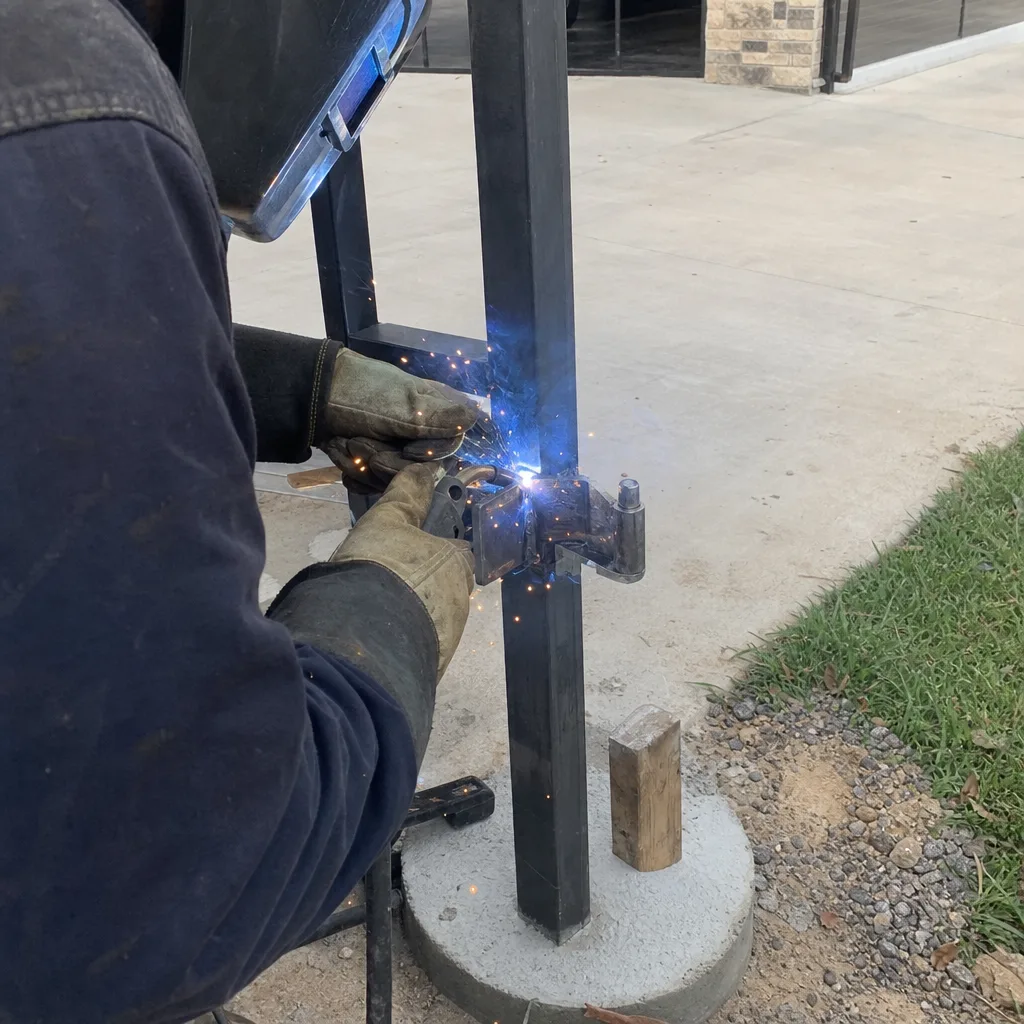
Sound is the most diagnostic of the warning signs because each component has its own frequency. A homeowner doesn’t need training to tell a grind from a buzz; you just need the map. Here are the sounds we hear most often on Tomball service calls, and what they mean.
- Grinding: Metal-on-metal contact, almost always in the gate’s travel path. The leaf scraping the drive, a wheel against a warped track, or a hinge without lubrication. Inspect the path and the hinges before running the gate more.
- Clicking (single, repeating when pressing the remote): The operator’s relay or start circuit trying to engage. Usually a failing capacitor or start relay on the motor.
- Clicking (rapid, machine-gun style): The control board hunting or a low-voltage condition at the board. Often a failing transformer or a loose connection.
- Buzzing (with no gate movement): A motor under power but unable to turn. The coupling or the gear train has failed, or the gate is physically jammed. Stop and inspect immediately.
- Humming (steady, when the gate is idle): A transformer or capacitor that’s energized but failing. Intermittent hum from the box means heat or wear in a component that’s about to let go.
- Thumping or rhythmic knocking (during travel): A slide gate wheel with a flat spot, a chain that’s hit something, or a bent rack tooth. The thump will match the wheel rotation.
- Squealing or screeching: A dry bearing, a dry hinge, or belt slip on a belt-driven operator. If it’s a belt, the screech means the belt is about to glaze or snap.
Record the sound on your phone. A ten-second video held near the operator while the gate runs gives a technician more diagnostic information than a paragraph of description ever will.
How to Document a Warning Sign So a Technician Can Diagnose Remotely
The difference between a useful service call and a wasted one often comes down to what the homeowner captured before calling. Since Vance Gate Repair leaves a documented record on every visit, we think the homeowner should have the same habit. See our How to Hire a Gate Repair Contractor in Tomball: A Step-by-Step Guide for what to expect. Here’s what to capture.
- Photograph the symptom in context. A close-up of a rusted hinge tells us nothing without a wider shot showing where that hinge sits. Take one wide shot, one medium, one close. Put a coin, a key, or a finger in the close shot for scale.
- Time the cycle. Use your phone’s stopwatch. Open from closed: how many seconds? Pause before moving: how long? Full close: how many seconds? Note any point where the gate changes speed.
- Record the sound. Ten seconds, stationary phone, from three feet away. Then ten more from inside the house, for contrast if the noise is loud enough to hear indoors, which matters.
- Note the conditions. Time of day, temperature, whether it rained in the last 24 hours, whether the gate had been used in the last hour. Tomball weather is part of the diagnostic picture.
- Photograph the operator nameplate. The brand, model, and serial number are usually on a label inside the operator housing or on the side of the motor. A clear photo saves a site visit’s worth of back-and-forth.
Send these to the technician before the visit, or have them ready when you call. What you’re doing is giving the tech a head start on the diagnosis. In our experience, a documented call is a shorter call, and a shorter call is a less expensive call.
Scheduled Repair vs. Imminent Failure: Which Signs Allow a Window

Every warning sign exists somewhere on a spectrum from “schedule it this month” to “stop using the gate now.” Knowing where your symptom falls prevents both expensive surprises and false alarms.
Signs that allow a scheduled window: a slowly drooping leaf, a rust bloom at a hinge, a keypad button that needs a second press, a remote whose range has shortened over months, a gate that runs a little slower than last season, a photo-eye that faults in certain light. These are progressive, and a service visit within a few weeks is usually soon enough.
Signs that mean the failure is imminent: any new grinding or metal-on-metal sound that wasn’t there last week, a motor that runs without moving the gate, a breaker that trips repeatedly, a loud buzz with no movement, a gate that reverses mid-cycle for no reason, smoke or burning smell from the operator. These demand immediate action: cut power at the breaker, stop using the gate, and call a technician. Do not try to muscle the gate open or closed; a gate under tension can move unpredictably, and a two-ton leaf that moves when you’re not expecting it can cause serious injury.
The rule we give Tomball customers is simple: if the gate makes a new noise or does something it never did before, treat it as relevant. The gate doesn’t develop quirks. It develops symptoms.
Common Mistakes to Avoid
- Lubricating the wrong thing. Spraying the operator housing with WD-40 doesn’t help a motor. Greasing a photo-eye lens makes it worse. If you’re unsure what to lubricate, ask first.
- Ignoring a new sound because the gate still works. The gate will keep working until the moment it doesn’t, and that moment tends to be a morning when you’re already late. Tomball driveways are configured so the gate fails when the car is inside the property line more often than not.
- Adjusting limit switches by feel. A limit switch set twelve degrees past travel will eventually break the gear train. Limit setting is a measurement job, not a feel job.
- Assuming the remote battery is the problem whenever range drops. Replace the battery if you want, but if both remotes fade at once, the receiver or the antenna is the issue and a new battery won’t touch it.
- Waiting for the gate to stop completely before calling. The best repair is the one done before the component fails completely, when the part to replace is a capacitor instead of a gear train. Every gate repair in Tomball is cheaper and faster when the motor hasn’t been asked to destroy itself first.
- Powering through the gate. Holding the remote button down, pressing repeatedly, or forcing the leaf by hand when the operator is sluggish teaches the motor a bad lesson. It doesn’t fix the bind; it masks it until the motor burns out.
- Closing a broken gate behind you and walking away. If the gate failed closed and you leave it that way, the next failure may happen when someone who can’t move it needs to get out. Secure what you need to secure, but leave the gate in a position that doesn’t trap vehicles.
When to Call a Professional
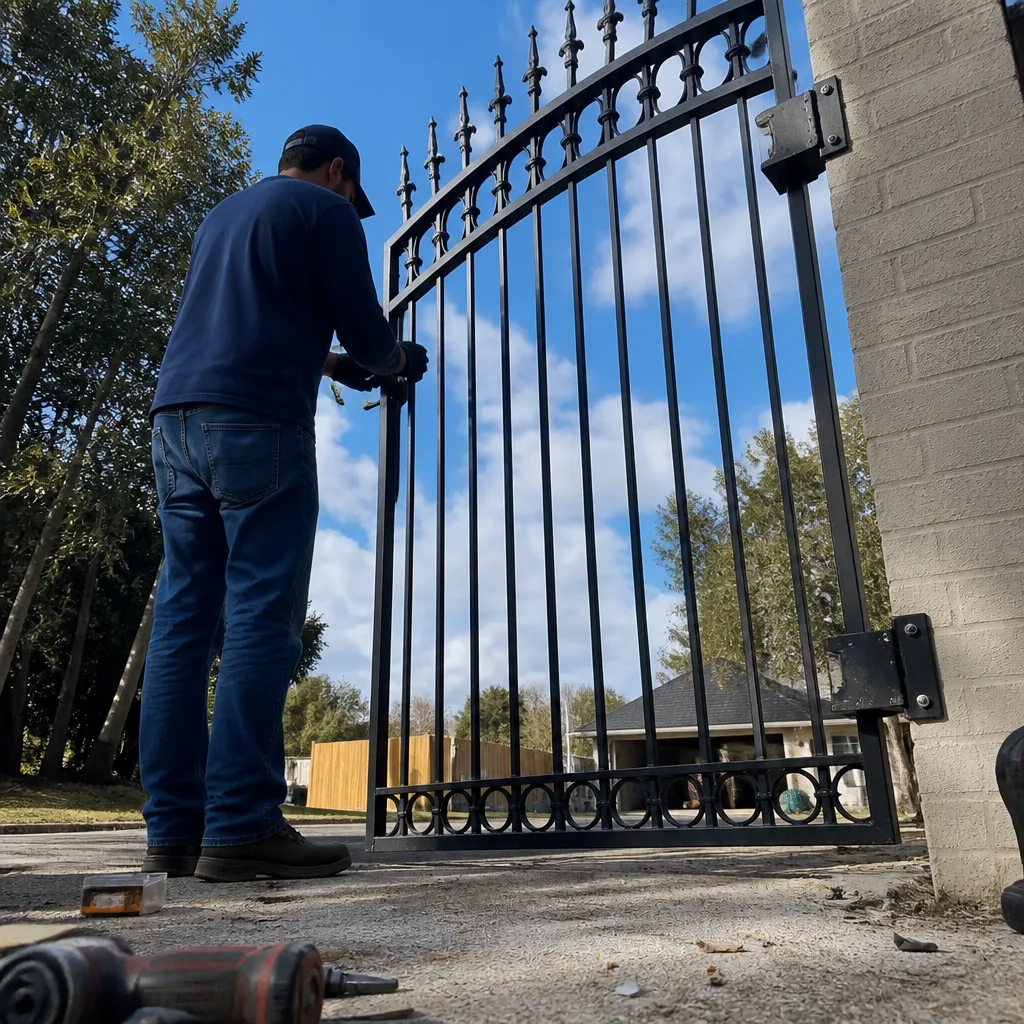
A gate that’s been making a new noise for a week, a leaf that’s visibly lower at the latch side, an operator that buzzes without moving, or a breaker that’s tripped more than once: these are not conditions to web-search through, they’re conditions to diagnose. Automatic gates combine a heavy moving leaf with electrical power and a control system that decides when to move it. When any one of those three systems shows a warning sign, the safest and cheapest move is to bring in a technician who can identify the failure, fix it with the right part, and leave you a written record of what was done. There is a real injury hazard in a gate that moves unpredictably, and the best we can do for you is show up, find the fault, quote the price in writing before anything comes off the truck, and stand behind the work for a year. Gate Repair in Tomball is what we do every day. Vance Gate Repair Tomball offers free estimates in Tomball, call (346) 248-7685.
Frequently Asked Questions
Most gate repairs in Tomball fall between $150 and $650 depending on the fault, with typical component replacements like photo-eyes, keypads, or capacitors running $175 to $375, and a full swing-gate motor replacement usually $850 to $1,600 depending on the brand and how much of the existing bracket and wiring can be reused. The price is quoted in writing before any work starts, so you’ll know the exact number before we begin. Call (346) 248-7685 for a free estimate.
Yes, in most cases. A bad capacitor, a failed relay, a corroded limit switch, or a snapped belt on brands like Linear or Ghost Controls can often be diagnosed and repaired the same day we arrive, because we keep common parts stocked and we don’t have to order blind. Call us; if we can’t repair it today, we’ll tell you that before you commit to anything.
A proper install includes the gate leaf or leaves, the posts set in concrete at the right depth for the soil, the operator and all wiring, the photo-eyes and safety edges, the access control devices you choose, and a documented photo record of the completed work. We cover gate installation in Tomball with the same Gate Installation in Tomball process we use on every job: written scope, written price, and a document trail when we leave.
Yes. The low-voltage run from the house to the gate, the photo-eye wiring, the safety edges, and any keypad or intercom wiring are all part of the scope we quote. A gate operator and its safety devices are one system, and we don’t leave one without the other working.
We service LiftMaster, FAAC, BFT, Linear, Viking, Ghost Controls, DoorKing, Elite, and Mighty Mule. We repair what’s already on the property rather than pushing a replacement toward a brand we happen to carry. Our Gate Motor & Opener in Tomball service covers all nine brands.
First, check the area around the gate path for anything that might have crossed the photo-eye beam, then note the time of day, the weather, and exactly where in the travel the reversal happens. A gate that reverses on its own is telling you the operator is receiving false input from an obstruction sensor, a safety edge, or a failing limit. Cut power if it continues, and call us at (346) 248-7685 with the details.
Yes. Bring us the written estimate and we’ll review it at no cost, line by line. We’ll tell you if the scope is right, if the price is fair, and whether there’s a less invasive repair path. Free second opinions are part of how we price in writing and expect everyone else to.
The Bottom Line
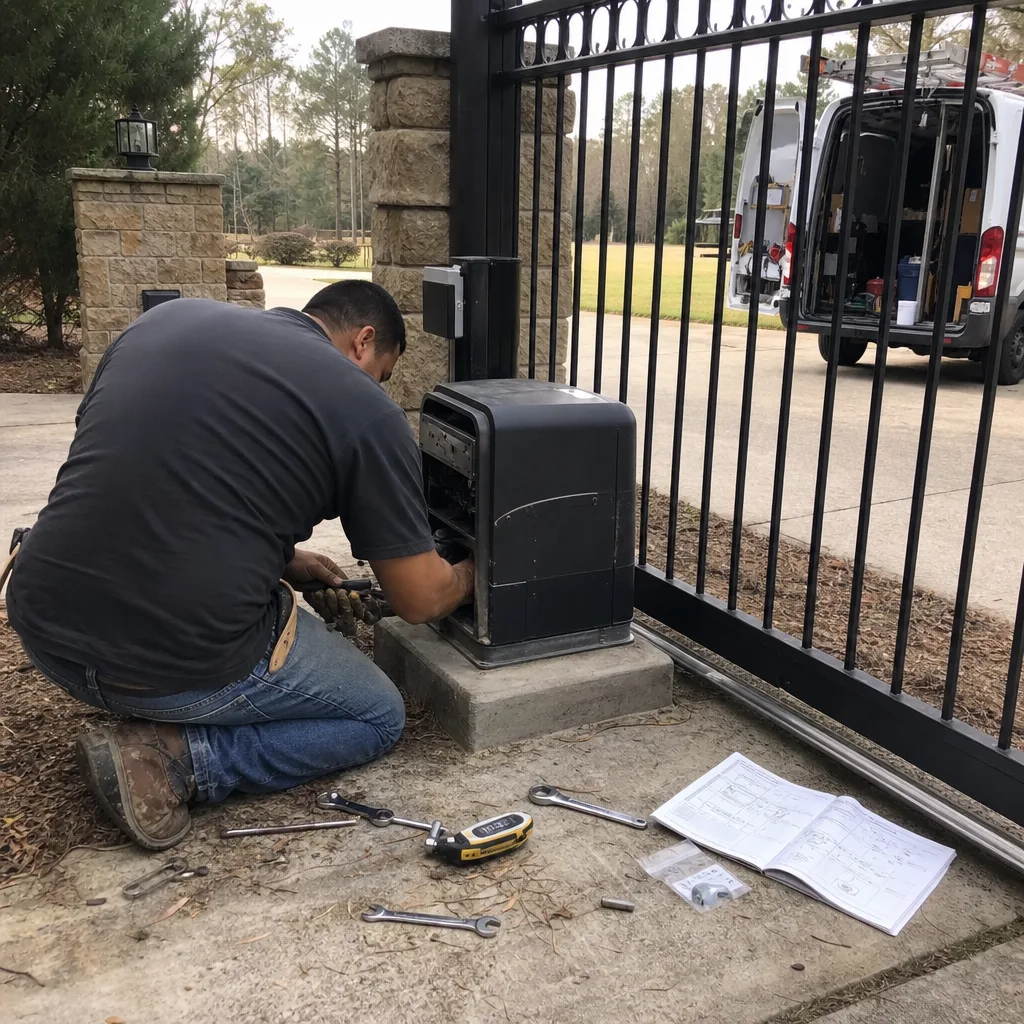
Every gate failure gives warning. The sound it makes, the pause before it moves, the rust at the weld, the keypad button that needs pressure twice: these are not quirks, they are data. And the homeowner who reads them early saves money and hassle that the homeowner who ignores them pays later. Tomball’s climate and soil add their own signatures to the warning signs, and knowing them gives you a head start. We built Vance Gate Repair Tomball on the idea that a gate repair should be documented like a commercial project: a written price before work begins, a photo record when the work is done, and a promise that if it isn’t right, we make it right for 365 days. If your gate is telling you something, call (346) 248-7685 and tell us what you’re hearing. We’ll take it from there.
Written by Adrian Vance, Owner at Vance Gate Repair Tomball home, serving Tomball since 2014.