
Last updated September 20, 2026
Free on-site gate assessment - hinges, posts, and your LiftMaster or Nice gate operator checked before anything is quoted
The assessment is free and the quote is the invoice.


 Before
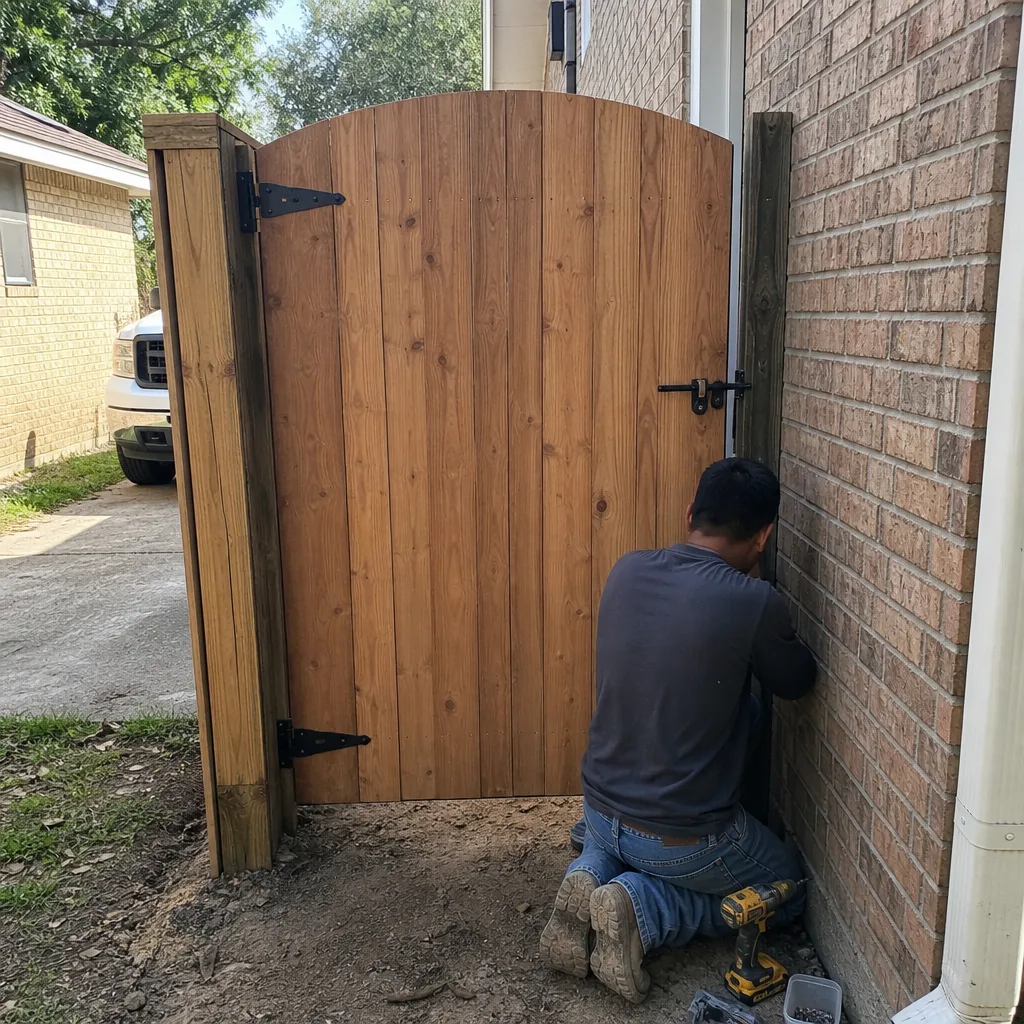 After
After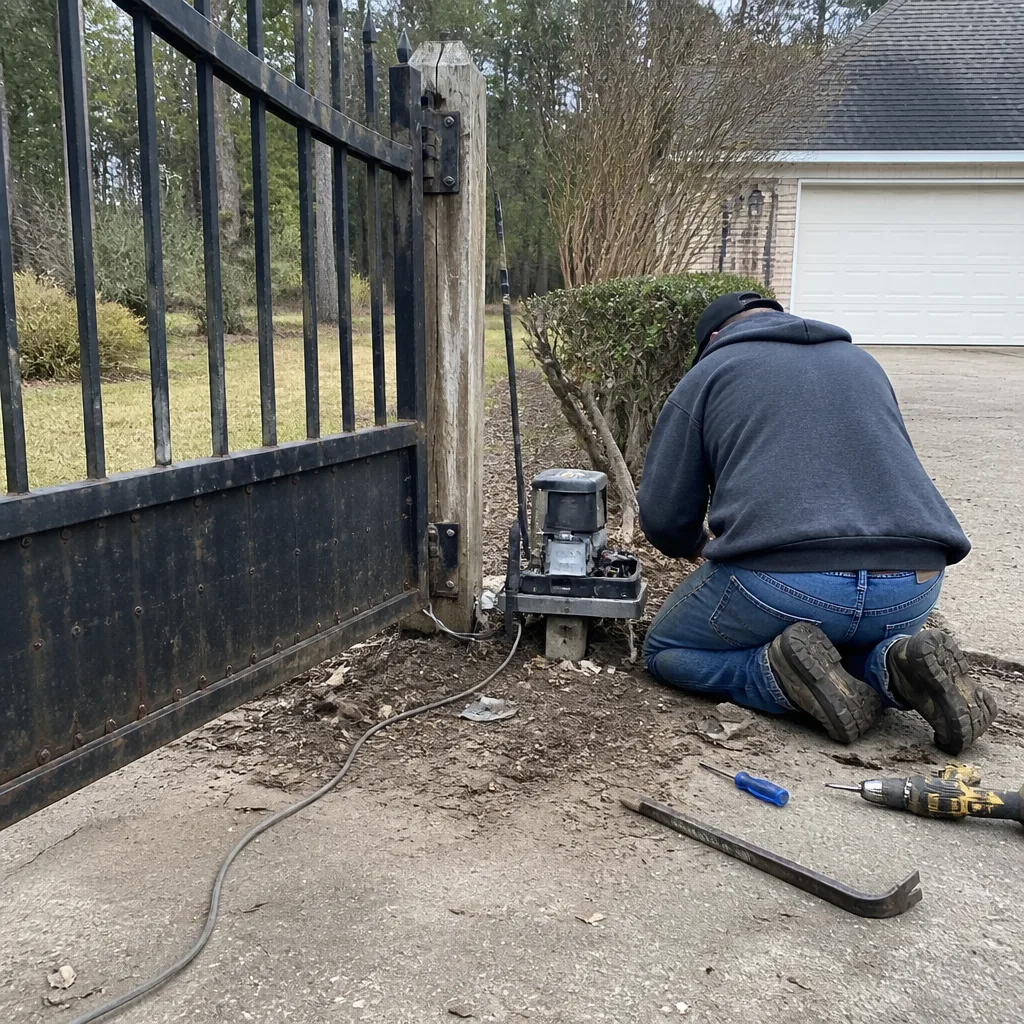 Before
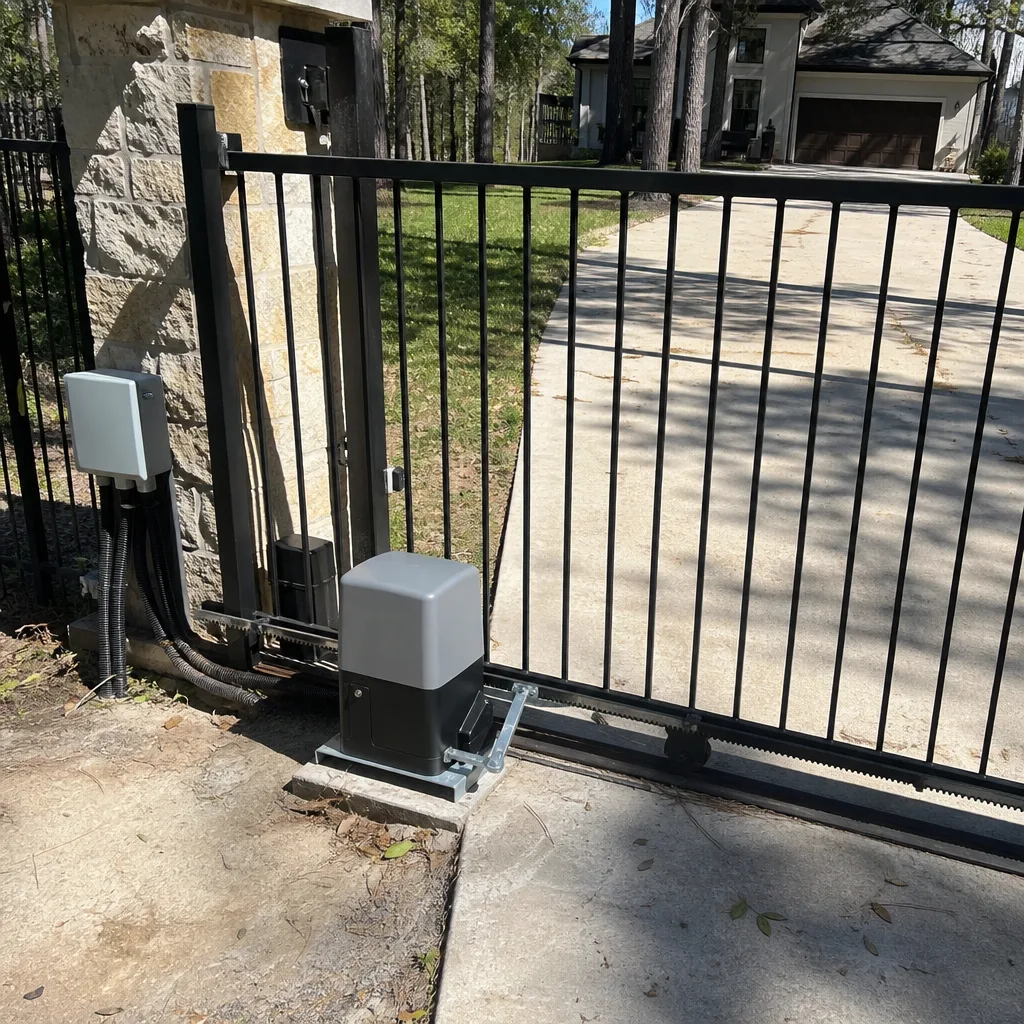 After
After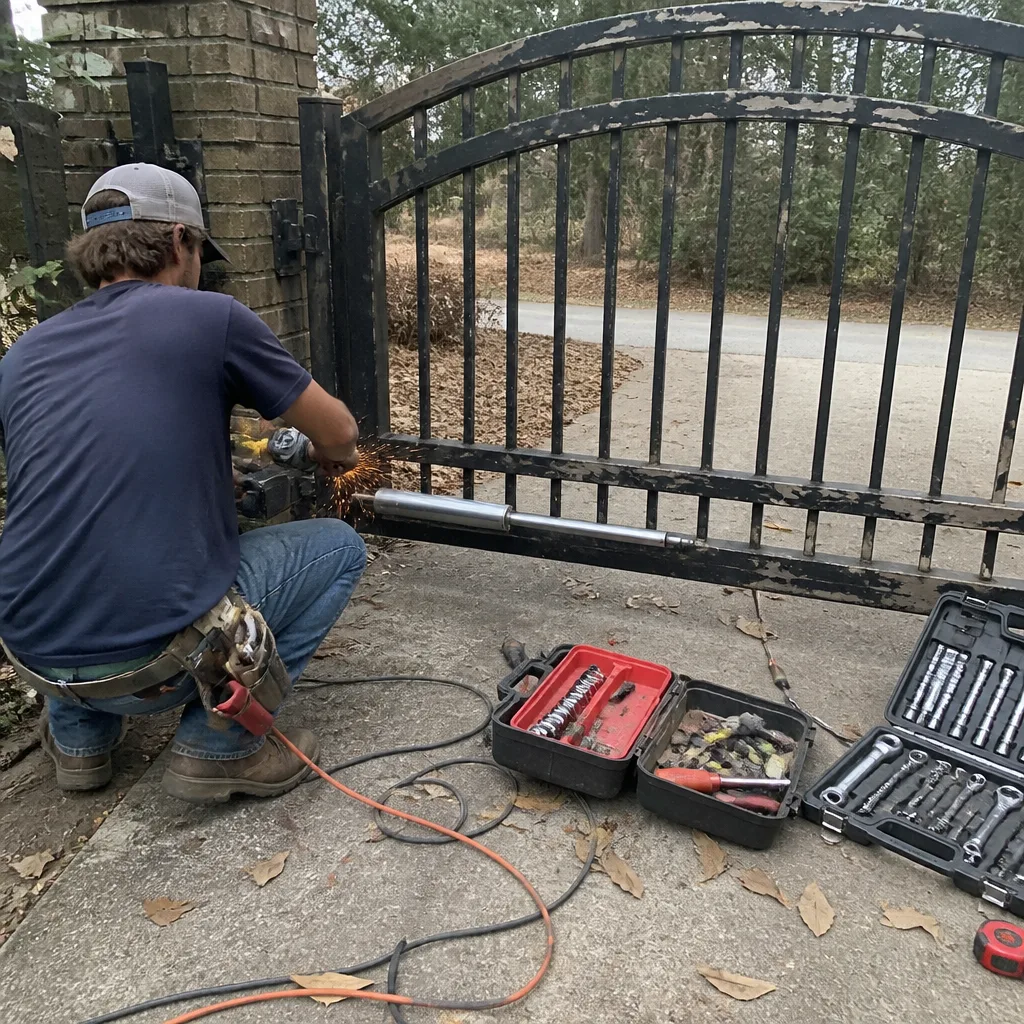 Before
 After
AfterHow to Hire a Gate Repair Contractor in Tomball: A Step-by-Step Guide
A five-star review can’t tell you whether the technician left a wiring diagram. It can only tell you the homeowner was happy, until the next technician charges them to rediscover the same system. In Tomball, where a single afternoon storm can throw a gate sensor out of alignment and a week of humidity can swell a wooden gate frame, that distinction matters more than most people realize. Our Complete Guide to Gate Repair in Tomball gives you a hiring framework built around documentation standards, not star ratings. You’ll learn the five questions to ask before scheduling, what a written scope must include to be useful, the red flags unique to gate contractors, and how to compare two quotes line by line.
Quick Answer
Hire a gate repair contractor in Tomball by asking for a written scope before any work begins, not just a verbal estimate. The contractor should document part numbers, labor breakdown, and exclusions in writing, photograph existing wiring before touching it, and leave you with a post-job record of every adjustment. If they won’t put the price in writing before work starts, keep looking.
Table of Contents
- Why Documentation Predicts Quality Better Than Reviews
- The Five Questions to Ask Before Scheduling
- What a Written Scope Must Include to Be Useful
- Red Flags Unique to Gate Contractors
- How to Compare Two Written Quotes Line by Line
- The Post-Job Documentation Standard
- Tomball-Specific Considerations for Gate Repair
- Common Mistakes to Avoid
- When to Call a Professional
- Frequently Asked Questions
- The Bottom Line
BeforeAfterWhy Documentation Predicts Quality Better Than Reviews
We’ve repaired over 22,000 gates since 2014, and the pattern we see on second-opinion calls in Tomball is consistent: the previous contractor left no record of what they did. No part number, no adjustment settings, no photo of the wiring before they touched it. The homeowner paid for a repair, got a gate that worked for a while, and now owns a system nobody can diagnose without starting from zero. That’s not a repair. That’s a lease on temporary function.
A review tells you the customer felt good about the interaction. It cannot tell you whether the technician set the limit switch correctly or whether the motor that was installed matches the torque requirements of the gate. Documentation tells you that. A contractor who writes down what they found, what they changed, and what they installed is a contractor who expects to be accountable for the work later. That’s the habit you’re screening for.
The reason this matters more for gates than for other home systems is complexity. A driveway gate combines mechanical parts, electrical components, and often access-control logic in one assembly. When the gate fails six months later, a technician without records has to spend billable time reverse-engineering the system. A technician with records starts from the last known state. In Tomball, where many homes have custom gates built by local fabricators, there’s no universal wiring standard. Every gate is a small bespoke system. Without documentation, every new visit is an archaeology project.
This is why Vance Gate Repair Tomball home operates under what we call the Haven Standard: a written scope, a written price, and photographic evidence on every single visit. It’s not a marketing promise. It’s the same habit Adrian Vance carried over from commercial access-control work starting in 2014, where undocumented changes to a card-reader system can strand an entire building’s security. Our 22,000-plus gates repaired and installed since then each got a written price before the job started and a documented record when the technician left.
The Five Questions to Ask Before Scheduling
These five questions will tell you more about a Tomball gate contractor in ten minutes than an hour of reading reviews. Ask them directly, on the phone or by email. The hesitation you hear in the answer is the answer.
- “Do you provide a written price before any work begins?” This is the non-negotiable one. A contractor who wants to give you a verbal estimate and “see how it goes” is telling you they reserve the right to redefine the price after the gate is in pieces. Under Clause 1 of the Haven Standard, the flat price is written and handed over before any work starts. If another contractor won’t do that, you have your answer.
- “What documentation do you leave when the job is done?” A vague answer like “we’ll show you it works” is not documentation. You want to hear specifics: part numbers installed, adjustment readings, photographs of the wiring before and after. If the contractor looks confused by the question, they’ve never been asked to prove their work.
- “Which gate automation brands do you service?” A contractor who only works on one brand will steer you toward replacing whatever you have. We service nine major brands including FAAC, BFT, and Linear, so the answer to “can you fix my motor?” is almost always yes, regardless of what’s bolted to the post. If a contractor starts explaining why you should replace your FAAC opener with the brand they sell, be skeptical.
- “Will you photograph the existing wiring before you start?” This question catches a lot of contractors off guard, and that’s the point. Photographing the existing setup before touching anything is how you prevent the “your wiring was already like that” conversation later. A contractor who resists pre-work documentation is a contractor who doesn’t want a baseline on record.
- “Who answers the phone if the gate fails at 11 p.m.?” Gate failures don’t respect business hours. A gate stuck open at midnight is a security exposure. A gate stuck closed at 7 a.m. is a missed workday. If you can’t get a live person, the emergency isn’t really covered. We keep a live person answering calls 24 hours a day, seven days a week, because a gate emergency at hour 23 is still an emergency.
What a Written Scope Must Include to Be Useful
“Replace motor: $950” is not a scope. It’s a price with a noun attached. A useful written scope tells you what the contractor thinks is wrong, what they’ll do about it, what parts they’ll use, and what they explicitly will not do. If the scope doesn’t contain those four elements, you’re comparing total dollar figures without knowing what those figures buy.
Here’s what a written scope should contain, line by line:
- The diagnosis in plain language: “Gate fails to open from remote; limit switch is set 12 degrees past travel, causing motor overload shutdown.” You should be able to read the diagnosis and understand the problem without a technical dictionary. If the diagnosis is only “gate broken, needs repair,” that’s not a diagnosis.
- Part numbers, not just part names: “FAAC 790 operator arm” is useful. “New arm” is not. The part number lets you verify what was installed, check whether the price is reasonable, and source a replacement if the part fails under warranty later. Contractors who won’t list part numbers are either disorganized or deliberately obscuring their markup.
- Labor broken out separately: The labor line should tell you how many hours of work are expected and at what rate. Without a labor breakdown, you can’t evaluate whether a repair is expensive because the part is costly or because the labor estimate is inflated. One of those is legitimate. The other is padding.
- Scope exclusions, stated explicitly: “This price covers the motor replacement and limit switch reset. It does not include repair of the photo-eye wiring, which is functioning but shows corrosion and may need attention within 12 months.” That sentence is gold. It tells you what you’re not getting, which means you won’t be surprised later, and it flags a future issue without converting it into an upsell.
- Warranty terms in writing: What’s covered, for how long, and what you need to do to claim it. This is standard with Gate Repair in Tomball from any contractor who expects to honor the work. If the warranty is verbal, it doesn’t exist.
A useful scope reads like a small contract, because that’s what it is. It gives you something to hold the contractor to and something to hand the next contractor if the relationship goes sideways.
Red Flags Unique to Gate Contractors
General contractor red flags apply: no license, no insurance, demands for full payment upfront. But gate work has its own warning signs, and they’re subtle. These five signals are specific to the trade and tell you more than a missing insurance certificate would.
- Verbal-only estimates on a repair that’s already been diagnosed. A gate technician who won’t write down a price for a motor swap before starting is telling you they expect the number to change. That’s not caution; that’s strategy.
- Reluctance to photograph existing wiring before work begins. This one surprises people. Why would a contractor resist taking photos? Because the photos create a record of the gate’s true condition before they touched it. If the work goes wrong, that record makes it easier for you to hold them accountable. A contractor who doesn’t want pre-work photos is a contractor who doesn’t want accountability.
- Bundled pricing that obscures individual repair costs. “Complete gate service package: $1,450” tells you nothing about what’s included. Is that a motor, two hinges, and a photo-eye, or is it one motor and a lot of description? Bundled pricing is how contractors hide a cheap repair inside an expensive package.
- Immediate replacement steering. You called about a gate that won’t open. The contractor spends twenty minutes explaining why your BFT opener is obsolete and you need a whole new system. Sometimes replacement is genuinely the right call, but a contractor who leads with replacement before diagnosing the fault is selling you inventory, not solving your problem.
- No answer when you ask who performs the work. Some gate companies sell the job and then subcontract it to whoever’s available. Ask: “Who will be at my property, and can you tell me their name before they arrive?” We dispatch background-checked, uniformed technicians with a name and photo provided before arrival. If the contractor can’t tell you who’s showing up, you’re hiring a lottery ticket with a gate attached.
How to Compare Two Written Quotes Line by Line
You’ve done the screening. Two contractors have given you written scopes. One is $680, the other is $920. The instinct is to take the lower number. Resist it until you’ve compared the actual lines.
- Compare the diagnosis first. If one scope says “limit switch reset” and the other says “motor replacement,” they’re not quoting the same job. Before you compare prices, find out why the diagnoses differ. Sometimes one contractor is being conservative. Sometimes one is wrong. Never proceed until you understand the gap.
- Check the part numbers line by line. Same part on both scopes? Then the difference is labor, and you can ask why labor differs. Different parts? A Viking operator arm and a generic aftermarket arm are not the same product, and the price gap reflects that. Cheap aftermarket parts on a gate that cycles hundreds of times a month is a false economy.
- Look for the missing line. The $680 scope might be cheaper because it omits the photo-eye realignment that both contractors flagged as necessary. That’s not better value. That’s a narrower scope dressed up as a better price. A lower price is only meaningful when the scope is identical. When the scope is narrower, the lower price costs more later.
- Compare the warranty, not just the price. A $680 repair with a 30-day warranty is more expensive than a $920 repair with a 365-day warranty if the gate fails in month six. We cover every completed repair with the 365-Day Done Right Promise: if the repair is not right, we make it right, no argument, no fee, within that full year.
- Look for what they left out of the exclusions. A thorough scope lists what it doesn’t cover. A thin scope omits exclusions because the contractor wants to argue about them later. The quote with a longer exclusion list is often the more honest document.
We offer a free second opinion on any written estimate from another company. Bring the paperwork, and we’ll review it at no cost. That’s not a sales tactic; it’s a standing offer, because we’d rather you know what you’re comparing than guess.
The Post-Job Documentation Standard
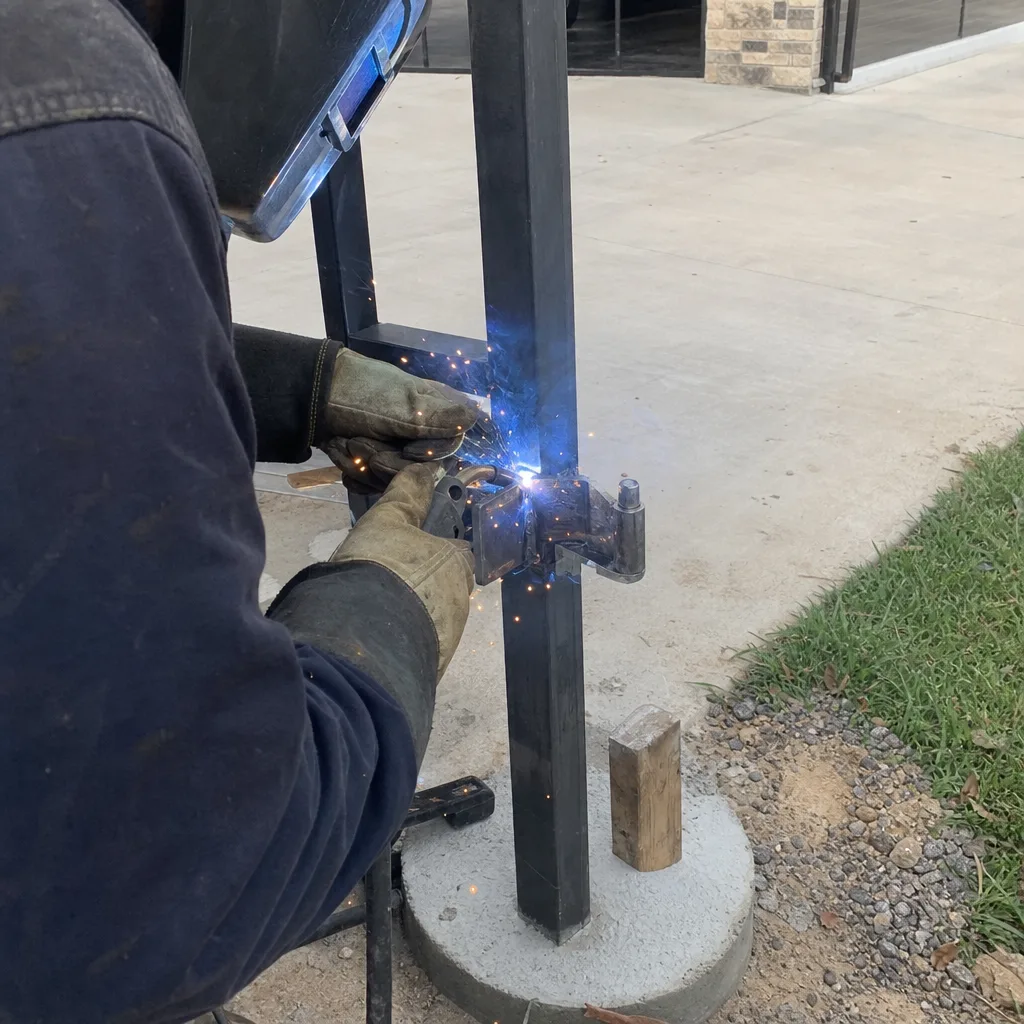
When the technician finishes and the gate swings properly, most homeowners sign the invoice and close the door. That’s a mistake. The moment the job is done is the moment you should collect the documentation that makes the repair durable. Here’s what you should receive before the technician drives away:
- A written record of what was found: The diagnosis in writing, including the specific readings or observations that led to it. If the technician found a limit switch set wrong, the record should say what it was set to and what they reset it to.
- A written record of what was installed: Part numbers, not descriptions. If a FAAC operator arm was replaced, the record should say “FAAC part 790780” or whatever the correct number is. This is what makes the repair traceable six months later.
- Photographs of the work: Before and after photos of the wiring and installation. We include a documented photo record on every visit as part of Clause 4 of the Haven Standard, Evidence on every job. The photos are left with you and filed in our job record.
- Adjustment settings documented: If the technician changed the close force, the open limit, the auto-close timer, or the photo-eye alignment, those numbers should be written down. A future technician who knows the gate was set to a 14-second auto-close doesn’t have to guess why it’s behaving oddly.
Store this documentation somewhere you’ll actually find it: a folder in the garage, a digital file, or stapled inside the gate motor housing cover if the weather rating allows. The point is that the next person who touches the gate, whether that’s you in six months or a different contractor in six years, starts from the documented state instead of from zero. The single most expensive line item in gate repair is rediscovery: paying a technician to figure out something that should have been written down the first time.
Tomball-Specific Considerations for Gate Repair
Tomball’s climate and market shape gate repair in ways a general guide from a national site won’t tell you, which is why we publish Seasonal Gate Repair Care for Tomball: Year-Round Homeowner’s Guide. The humidity is the first issue. Gate motors in Tomball live in an environment that swings from 95-degree summer heat to damp winter mornings. Condensation inside the motor housing is common, and it accelerates corrosion on wiring connections. A technician who’s worked Tomball’s climate knows to check the seal on the motor housing and the condition of the wiring insulation, not just the mechanical components.
The second Tomball-specific factor is the prevalence of custom gates. A drive through neighborhoods north of FM 2920 or east toward Hooks Airport shows you gates built by local fabricators, each one a one-off. There’s no standard wiring diagram for these gates because there was never a standard. That’s why we treat residential gates with the same documentation discipline we learned on commercial access-control systems: wire colors get noted, connection points get photographed, and the record stays with the gate.
The third factor is local code. Tomball requires permits for some gate installations depending on setback and driveway configuration, and a contractor who knows the local process saves you a call to the city. The same applies to Gate Installation in Tomball: a company that’s pulled permits in the area knows what the building department will ask for. That’s not universal knowledge; it’s local knowledge accumulated across hundreds of jobs.
The fourth factor is the market itself. Tomball has enough gate contractors that you can be selective, but the range of documentation standards is wide. Some operate like the commercial access-control companies they once worked for, with written scopes and service records. Others operate like handyman services that happen to fix gates. The gap between those two ends of the market is where every regretful hiring decision lives.
Common Mistakes to Avoid

- Hiring on price alone without comparing scope. The $400 quote that fixes the symptom and not the cause will be followed by a $900 quote to fix the cause three months later. In Tomball, where gate failures tend to recur in the same season they first appeared, that cycle repeats until someone documents the actual fault.
- Accepting a verbal estimate on a repair. If the contractor won’t write it down, you can’t hold them to it. A verbal estimate is a conversation; a written price is a commitment. The difference is what separates Gate Motor & Opener in Tomball work that stays fixed from work that gets rediscovered.
- Letting the contractor skip the pre-work photos. Without a baseline photo of the existing wiring and configuration, you lose your only objective record of what was there before. If something goes wrong, the argument becomes your memory against theirs. With the photo, it’s not an argument.
- Failing to ask about the warranty in writing. A warranty that isn’t in writing doesn’t exist. Ask what’s covered, for how long, and what voided the last warranty claim the contractor dealt with. Their answer to that last question tells you how they treat customers after the invoice clears.
- Throwing away the documentation. The photo log and written record you receive after a repair is the single most valuable artifact of the job. Fold it, file it, keep it. When the gate acts up two years later, the next technician can start from the existing record instead of spending an hour rediscovering the system at your expense.
- Assuming all gate contractors service all brands. Many Tomball contractors specialize in one or two automation brands and steer everything else toward replacement. If your gate has a Viking motor and the contractor only installs a different brand, the quote they give you will almost certainly be for a full system replacement instead of a repair. Ask upfront about brands.
When to Call a Professional
Some gate work is safely DIY: lubricating hinges, clearing debris from the track, tightening a loose bracket. But the moment the problem involves a motor, a limit switch, a photo-eye, or any electrical component, call someone who does this every day. Gate motors carry enough force to injure, and the high-tension springs on some gate designs are genuinely dangerous if released incorrectly. A misdiagnosed limit switch can cause a gate to overshoot its travel and damage the motor, the hinge, or the post. If the gate is making a new sound, moving unevenly, or failing intermittently, the cheapest fix is the one done correctly the first time. Vance Gate Repair Tomball offers free estimates in Tomball, call (346) 248-7685.
Frequently Asked Questions
Hire a Tomball gate repair contractor by screening for written documentation practices: ask for a written price before work starts, a written scope with part numbers and labor breakdown, and a documented record when the job is done. Then compare quotes line by line, not as total dollar figures. Call (346) 248-7685 for a written estimate on your gate repair.
A gate repair estimate should include a written diagnosis, specific part numbers, labor hours broken out separately, explicit scope exclusions, and warranty terms in writing. A single dollar figure with a noun attached (“motor replacement: $950”) is not an estimate; it’s a placeholder for a conversation about price changes later. We provide a written price with the full scope before any work begins.
The red flags specific to gate contractors are verbal-only estimates, reluctance to photograph existing wiring before work begins, bundled pricing that obscures individual repair costs, immediate replacement steering without a diagnosis, and no answer when you ask who will perform the work. Each of these signals an accountability gap. Ask about them upfront and watch how the contractor responds.
Gate repair costs in Tomball vary by component. A photo-eye realignment typically runs between $80 and $150. A limit switch reset is usually in the $100 to $180 range. A swing-gate motor replacement typically falls between $650 and $1,200 depending on the brand and whether the existing arm bracket is intact. Repairs involving control board replacement can reach $400 to $800. These are ranges for common repairs, not quotes. Call (346) 248-7685 for an exact written price on your specific gate.
After a gate repair, you should receive a written record of what was found, a written record of what was installed with part numbers, photographs of the work before and after, and adjustment settings documented in writing. This is the minimum standard for a repair that stays fixed and remains diagnosable by the next technician who touches the gate. We include this on every visit at no additional charge.
We service nine major gate automation brands including FAAC, BFT, Linear, and Viking, so the motor on your gate is likely one we work on regularly. Unlike contractors who specialize in one brand and steer toward replacement, we repair what’s already installed whenever repair is the right call. If you’re not sure what motor you have, call us and describe the housing; we’ll identify it over the phone.
The Bottom Line
Hire a Tomball gate contractor the way you’d hire any professional who touches systems you can’t see: on evidence, not enthusiasm. Ask for the written scope before scheduling. Check that the scope includes part numbers, labor breakdown, and exclusions. Watch for the red flags that gate work makes unique: verbal estimates, missing pre-work photos, bundled pricing designed to hide the actual repair cost. And when the job is done, collect the documentation and keep it where the next technician can find it. The contractor worth hiring is the one who acts like the work will be examined later, because that’s the contractor who does work worth examining. Call (346) 248-7685 for a free estimate, written before any work begins.
Written by Adrian Vance, Owner at Vance Gate Repair Tomball, serving Tomball since 2014. Explore more guides & resources on our blog.